
How Does A/B Testing Help Measure Hallucination Rates?
A/B Testing Help Measure Hallucination Rates
A/B testing is a widely used experimental method in artificial intelligence to compare the performance of two model variations and determine which one produces better results. This technique is particularly useful in evaluating hallucination rates, where AI generates incorrect, misleading, or fabricated information. By systematically testing different model versions and analyzing their outputs, A/B testing helps measure and reduce hallucinations, ensuring AI systems produce more reliable and factual responses.
One of the primary ways A/B testing helps measure hallucination rates is by providing a controlled environment for comparison. In a typical A/B test, two Al hallucination detection and accuracy improvement—one serving as the baseline (A) and the other as the modified version (B)—are exposed to the same input data. The outputs are then analyzed to determine which model produces fewer hallucinations. By directly comparing the hallucination frequency and severity in each version, researchers can identify improvements and fine-tune AI systems to enhance accuracy.
A key advantage of A/B testing is its ability to quantify hallucination rates through statistical analysis. Metrics such as false positive rates, confidence scores, and human evaluation feedback help determine which model version is more reliable. For example, in natural language processing applications like chatbots or text summarization, human reviewers can assess whether AI-generated responses are factually correct, partially incorrect, or entirely fabricated. By collecting and analyzing this feedback across thousands of test cases, researchers can identify patterns in hallucinations and adjust model behavior accordingly.
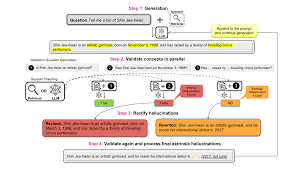
How Does A/B Testing Help Measure Hallucination Rates?
A/B testing also plays a crucial role in assessing the effectiveness of techniques designed to reduce hallucinations, such as retrieval-augmented generation (RAG), reinforcement learning from human feedback (RLHF), or fine-tuning with high-quality datasets. By testing AI models with and without these techniques, researchers can determine which approach leads to lower hallucination rates. If the modified model consistently produces more accurate outputs than the baseline, it confirms the effectiveness of the new method in reducing AI-generated errors.
Another benefit of A/B testing in measuring hallucinations is its adaptability to real-world applications. AI models often behave differently in controlled training environments compared to real-world usage. By deploying A/B tests in live settings, such as search engines, recommendation systems, or AI-generated content platforms, researchers can analyze hallucination rates based on real user interactions. This approach helps capture edge cases and unforeseen errors that may not appear during initial model training.
The iterative nature of A/B testing further enhances its effectiveness in minimizing hallucinations. AI models are continuously updated to improve accuracy, and each iteration can be tested against the previous version to measure improvements. By running A/B tests over multiple cycles, researchers can track long-term trends in hallucination reduction and ensure that new updates do not introduce unintended errors. This method is especially valuable for large-scale AI systems that require ongoing refinements to maintain accuracy and reliability.
Ultimately, A/B testing provides a structured and data-driven approach to measuring hallucination rates in AI models. By enabling direct comparisons, statistical analysis, real-world testing, and iterative improvements, A/B testing helps researchers refine AI systems and reduce the risk of generating false or misleading information. As AI continues to advance, the role of A/B testing in ensuring factual and trustworthy AI outputs will remain critical.